

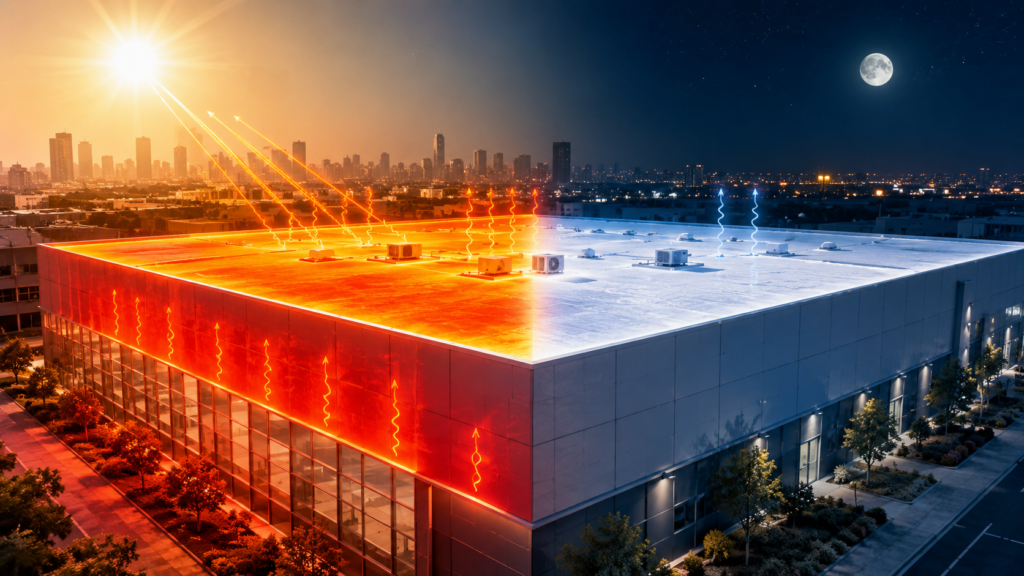
Building performance is often evaluated through energy consumption. While energy efficiency remains important, it reflects only part of a broader system governed by surface temperature, material response and urban microclimate.
Heat is not only an energy problem — it is a surface problem.
Approximately 55–59% of solar energy is carried by infrared radiation. When this energy is absorbed by roofs and façades, it accumulates within structural layers, increases surface temperatures and creates long-term thermal stress.
As a result, buildings act as heat reservoirs, releasing stored energy after sunset and contributing to the urban heat island effect.
Elevated surface temperatures accelerate material degradation, increase mechanical stress and reduce the efficiency of rooftop technologies such as photovoltaic systems. In industrial environments, excessive heat affects equipment reliability, working conditions and operational safety.
Surface temperature control addresses these effects at their source.
By reducing surface temperatures by approximately 27–43 °C under real operating conditions, heat accumulation within structures is significantly reduced. This leads to lower heat storage during the day, reduced night-time heat release and more stable indoor conditions. Cooling systems operate under lower load, peak demand is reduced and overall system stability improves.
In practice, this means cooler roofs, more stable interiors and significantly lower stress on building materials.
The impact becomes particularly significant on large roof areas — industrial halls, logistics centres and infrastructure — where surface treatments influence not only the building itself, but also the surrounding urban environment.
Measured reductions in surface temperature correlate with lower ambient temperatures and improved thermal comfort.
From an economic perspective, reduced thermal stress leads to longer service life of roofs and façades, lower maintenance requirements and improved operational reliability.
Surface-based thermal control is passive, durable and compatible with existing building envelopes.
Controlling heat at the surface is no longer an optimisation — it is a defining parameter of modern building performance.