

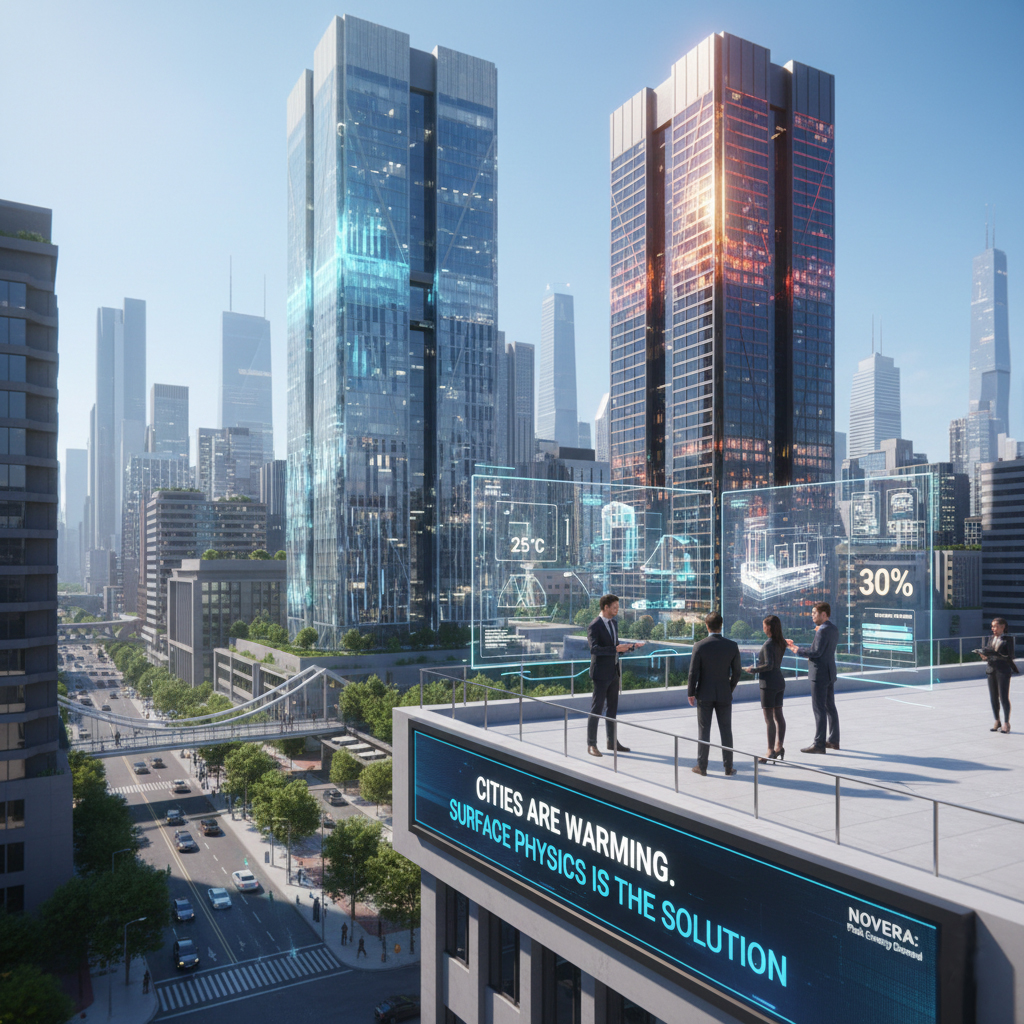
Cities are warming faster than ever before. This is no longer a theoretical projection, but a measurable reality affecting health, infrastructure, energy systems and the long-term stability of buildings. While much attention has been given to insulation, ventilation and mechanical cooling, the true origin of the problem lies elsewhere — at the surface of buildings, where solar energy first interacts with the built environment.
More than half of all solar radiation reaching a building exists in the infrared spectrum. When this energy is absorbed by roofs and façades, it accumulates within structural layers, elevates surface temperatures by tens of degrees and creates long-term thermal stress. Buildings become heat reservoirs, releasing stored energy long after sunset and intensifying the urban heat island effect.
Conventional solutions address the consequences rather than the cause. Insulation slows heat transfer but does not prevent heat absorption. Air conditioning removes heat at the cost of increased energy demand and additional waste heat released into the city. Even so-called “cool” or white coatings often operate only in the visible spectrum and fail to manage infrared radiation, emissivity and long-term performance.
The future of architecture cannot rely solely on thicker insulation or more powerful cooling systems. It requires a shift in how buildings interact with solar energy at the surface level. This is where surface physics becomes decisive.
By controlling reflection, emissivity and heat flow at the first point of contact, it is possible to prevent excessive heat from entering the structure at all. Lower surface temperatures reduce mechanical stress, slow material ageing, improve indoor comfort and decrease peak energy demand. When applied at scale, such technologies can influence not only individual buildings, but the thermal behaviour of entire urban districts.
NOVERA was developed precisely in response to this challenge. It does not seek to mask heat with colour or compensate for it mechanically, but to redirect it physically. By altering the interaction between light and surface, NOVERA transforms buildings from passive heat accumulators into active elements of urban thermal stability.
As cities adapt to a warmer climate, the role of surface physics will become as fundamental as insulation once was. The ability to manage heat before it enters the building envelope is no longer optional — it is a prerequisite for resilient, liveable cities.