

NOVERA is not the result of a recent innovation cycle or a market-driven trend. It is the culmination of more than four decades of scientific research led by Ing. Aloizy Thiel, whose work has focused on microsphere-based systems operating under extreme thermal and environmental conditions.
The origins of this research lie in advanced laboratory and industrial environments, where precise control of radiation, heat flow and material stability was critical. Rather than treating light as a visual phenomenon, the research approached it as a physical force that can be redirected, dissipated and controlled through material structure.
At the core of the technology are hollow ceramic and glass microspheres of varying sizes and refractive indices, embedded within a stable polymer matrix. These microspheres perform multiple functions simultaneously. Their spherical geometry enables multi-angle reflection of incoming radiation, including near-, mid- and far-infrared wavelengths. Their hollow core significantly reduces heat conduction, while the ceramic shell ensures long-term stability under UV exposure and thermal cycling.
Unlike conventional pigment-based coatings, whose performance depends on surface appearance and cleanliness, the physical effect of microspheres is volumetric. The functional properties are distributed throughout the entire layer, ensuring consistent performance even under contamination, dust exposure and long-term ageing.
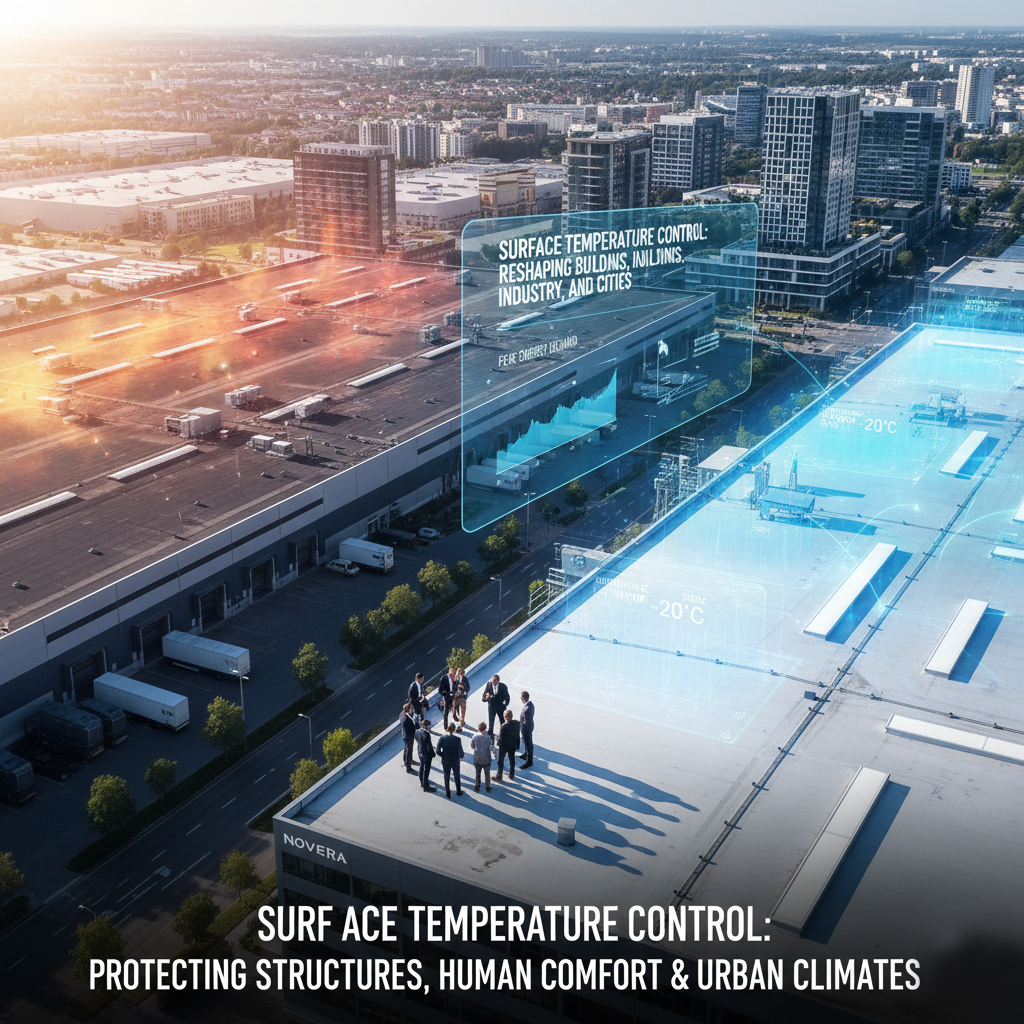
This physical approach is reflected in key measurable parameters. NOVERA achieves solar reflectance values of approximately 0.88, combined with high thermal emissivity of around 0.86. The result is a Solar Reflectance Index of approximately 107, placing the system among the highest-performing reflective surface technologies currently available. Under defined operational conditions, surface temperature reductions of 27–43 °C have been measured, with a corresponding reduction in heat flow into the structure of approximately 45–60%.
These results are not theoretical. The technology has been validated through a combination of long-term outdoor measurements, controlled laboratory testing and numerical simulation. University-led research programmes have confirmed both immediate thermal effects and long-term stability under real-world conditions. Accelerated ageing tests demonstrate that reflective and emissive properties remain stable over decades, far exceeding the service life of conventional coatings.
Importantly, NOVERA does not replace traditional insulation systems. It complements them by reducing thermal load at the surface, increasing the effectiveness and longevity of existing building envelopes. By acting at the first phase of heat transfer, it lowers structural stress, reduces cooling demand and stabilises thermal behaviour across a wide range of climates.
NOVERA represents the translation of lifelong scientific research into a practical, scalable surface technology. It is not an aesthetic solution, but a physical one — grounded in measurable data, validated by independent testing and designed for long-term performance.