
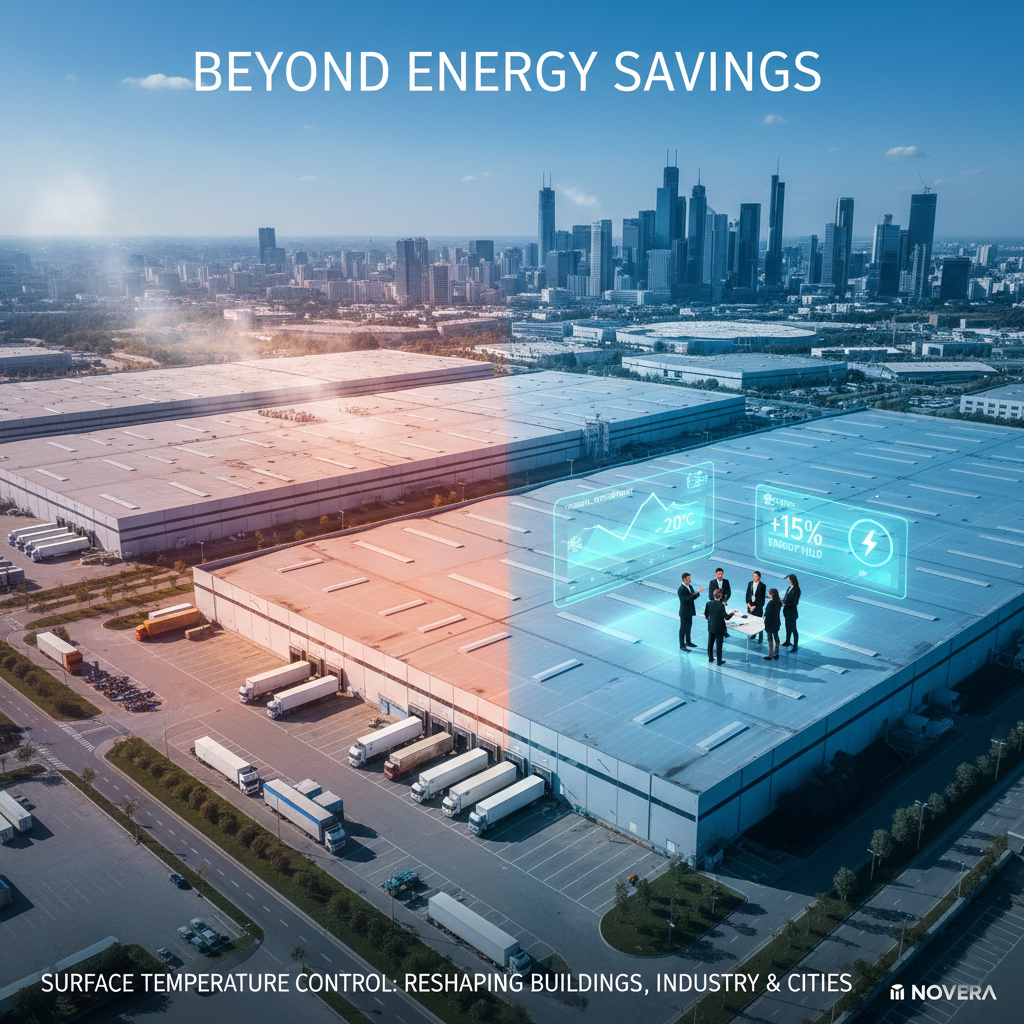
Discussions about building performance often focus narrowly on energy consumption. While energy efficiency is essential, it represents only one dimension of a broader system influenced by surface temperature, material stress and urban microclimate.
High surface temperatures accelerate material degradation, increase mechanical fatigue and reduce the efficiency of rooftop technologies such as photovoltaic systems. In industrial environments, excessive heat affects machinery reliability, working conditions and operational safety. At the urban scale, millions of square metres of overheated surfaces contribute directly to the urban heat island effect, increasing ambient temperatures and straining electrical grids during peak demand.
Surface temperature control addresses these challenges at their source. By reducing surface temperatures by tens of degrees, heat storage within structures is minimised, night-time heat release is reduced and indoor environments become more stable. Cooling systems operate under lower loads, peak energy demand decreases and infrastructure resilience improves.
The impact is particularly significant on large roof areas — industrial halls, logistics centres, airports and transport hubs — where surface treatments can influence not only the building itself, but the surrounding urban environment. Measured reductions in surface temperature correlate with lower air temperatures at street level and improved thermal comfort for occupants and nearby communities.
From an economic perspective, the benefits extend beyond energy savings. Lower thermal stress leads to longer service life of roofs and façades, reduced maintenance requirements and fewer structural failures. In industrial facilities, stabilised temperatures improve productivity, reduce equipment downtime and enhance occupational safety. In buildings with photovoltaic installations, lower operating temperatures can significantly increase energy yield and system longevity.
Crucially, these benefits are achieved without increased energy consumption or complex mechanical systems. Surface-based thermal control is passive, durable and compatible with existing building envelopes. It represents a shift from reactive cooling to preventive thermal management.
As cities confront rising temperatures, surface technologies such as NOVERA offer a realistic, scalable tool for adaptation. By integrating physics-driven solutions into the fabric of buildings, it becomes possible to protect structures, support human comfort and contribute to healthier urban climates over the long term.
The future of sustainable architecture will not be defined solely by what happens inside buildings, but by how their surfaces interact with light, heat and the environment. In this context, surface temperature control is not a marginal improvement — it is a foundational strategy for resilient cities.