

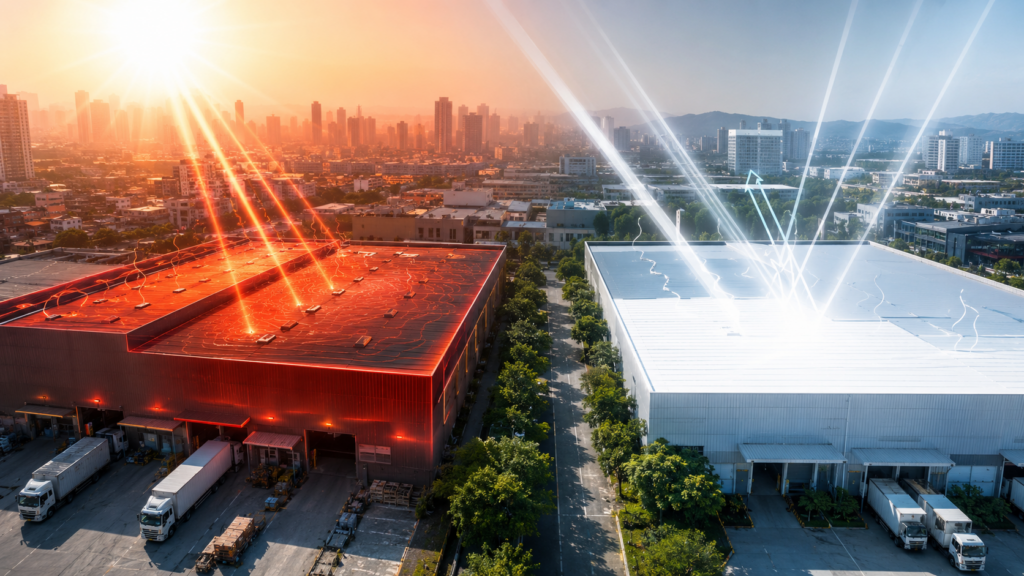
Once heat can be controlled at the surface, its impact extends beyond individual buildings to the scale of entire urban environments.
Urban areas are experiencing measurable increases in temperature, affecting building performance, energy demand and long-term structural stability.
The primary interaction between solar energy and the built environment occurs at the surface of buildings.
Approximately 55–59% of solar radiation lies in the infrared spectrum. When this energy is absorbed, surfaces overheat and buildings store and release heat over time.
As a result, buildings become active contributors to the urban heat island effect.
The future of building performance begins at the surface.
Conventional approaches primarily address consequences:
- insulation slows heat transfer but does not prevent heat absorption
- air conditioning removes heat at the cost of increased energy demand
- conventional coatings often fail to control infrared radiation and emissivity
These approaches do not control thermal behaviour at the surface.
By managing reflection, emissivity and heat flow at the first point of contact, heat penetration into the structure can be significantly reduced.
Surface temperature reductions of approximately 27–43 °C lead to:
- lower thermal stress
- reduced heat storage
- improved indoor stability
- reduced peak energy demand
In practice, this translates into more stable buildings, lower operational costs and improved long-term reliability.
At scale, the impact extends beyond individual buildings.
Large roof areas — industrial buildings, logistics centres and infrastructure — represent major sources of heat accumulation. Reducing surface temperatures across these areas contributes to lower ambient temperatures, reduced night-time heat release and improved urban microclimate.
Surface-based thermal control complements insulation and mechanical systems by reducing heat load before it enters the building envelope.
Technologies based on controlled infrared reflection, such as NOVERA, translate this physical principle into practical application — enabling buildings to shift from passive heat accumulation to controlled thermal behaviour.
The future of buildings will be defined not only by insulation, but by how effectively their surfaces control heat.