

Following the question of surface control, the next step is understanding how thermal behaviour can be engineered at the material level.
NOVERA technology results from more than 40 years of research led by Dip.-Ing. Alojzy Thiel in microsphere-based material systems operating under extreme thermal and environmental conditions.
Thermal behaviour can be engineered at the material level.
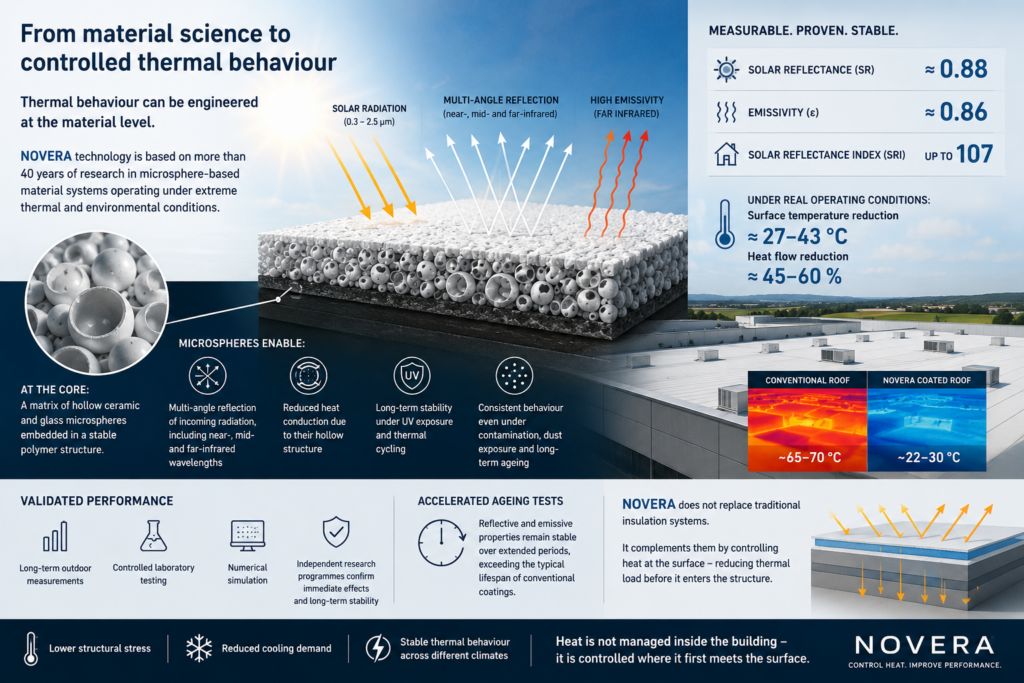
At the core of the system is a matrix of hollow ceramic and glass microspheres embedded within a stable polymer structure.
These microspheres enable:
- multi-angle reflection of incoming radiation, including near-, mid- and far-infrared wavelengths
- reduced heat conduction due to their hollow structure
- long-term stability under UV exposure and thermal cycling
Unlike conventional coatings, the functional effect is volumetric. The performance is distributed throughout the entire layer, ensuring consistent behaviour even under contamination, dust exposure and long-term ageing.
The system is defined by measurable physical parameters:
- solar reflectance (SR): approx. 0.88
- emissivity (ε): approx. 0.86
- Solar Reflectance Index (SRI): up to 107
Under real operating conditions, surface temperature reductions of approximately 27–43 °C have been measured, with corresponding heat flow reduction of approximately 45–60%.
Performance is validated through long-term outdoor measurements, controlled laboratory testing and numerical simulation. Independent research programmes confirm both immediate thermal effects and long-term stability.
Accelerated ageing tests demonstrate that reflective and emissive properties remain stable over extended periods, exceeding the typical lifespan of conventional coatings.
NOVERA does not replace traditional insulation systems. It complements them by controlling heat at the surface, reducing thermal load before it enters the structure.
This results in lower structural stress, reduced cooling demand and stable thermal behaviour across different climatic conditions.
Technologies based on controlled infrared reflection, such as NOVERA, enable this principle to be applied in real-world conditions at scale.
Heat is not managed inside the building — it is controlled where it first meets the surface.